
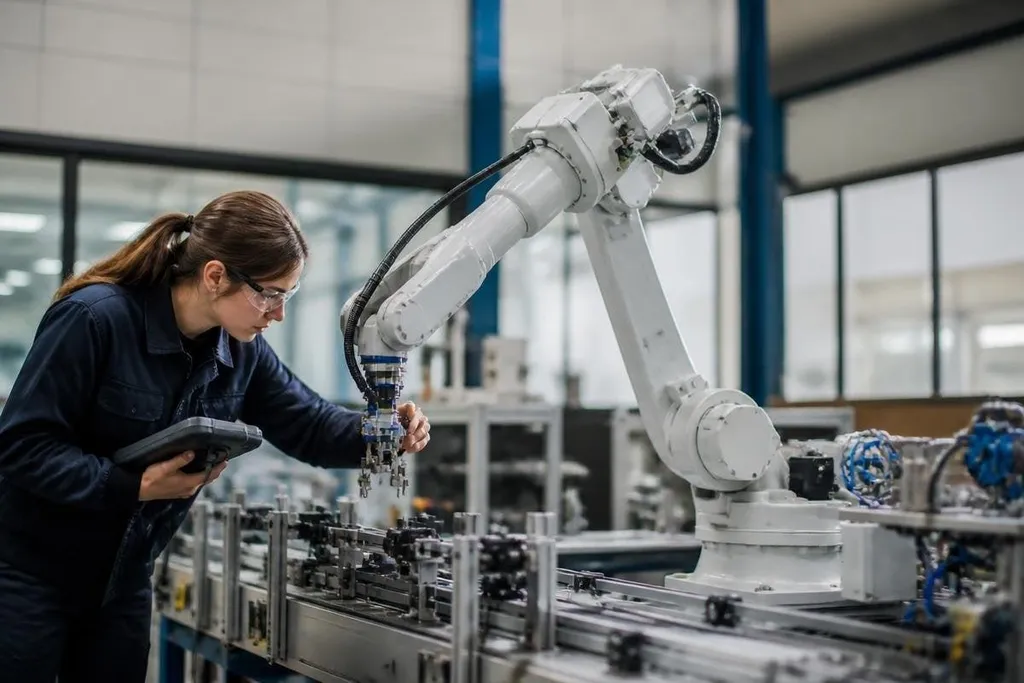
A robot can look ready in a lab and still fail on a factory floor. Robotics engineers are in high demand because they connect software, motors, sensors, people, and safety rules into one working system.
The work is hard to split into separate jobs. A change to the arm can alter the control code, power use, cycle time, and safety zone.
- Robots need engineers who can join mechanical parts with software.
- Factory work exposes faults that a clean lab test can miss.
- Demand grows as companies move a pilot cell into daily production.
Robots need several kinds of engineering
A robotics engineer may work on mechanical design, electronics, control systems, perception, or software. The role changes with each project, but the job always sits between fields.
The arm must reach the part without hitting nearby equipment. Its motors need enough torque, which is the turning force at a joint. Its camera must locate the part under changing light. The software then needs to plan a safe movement and report a fault when the part is missing.
Each task has a direct effect on the others. A heavier gripper can help with a larger payload, but it can also slow the arm and raise power use. A faster motion can shorten the cycle, but it may leave less time for the controller to react.
That is why a narrow skill set often falls short. A team may have strong programmers and still need someone who understands wiring, motor limits, calibration, and machine safety.
The gap between a demo and daily work
A demonstration usually controls the setting. The part sits in a known place, the floor is clear, and a person can reset the system between runs. Production removes those controls.
Parts arrive at different angles. Dust can affect a camera. A conveyor can stop. An operator may need to enter the work area. The robot has to handle these events without creating a new hazard or stopping the line for every small fault.
Engineers spend much of their time on this gap. They collect failure data, change the machine’s limits, adjust paths, and test recovery steps. The goal is not one successful motion. It is a system that can repeat the task across a full shift.
The hiring question starts with deployments. Each new site needs people who can tune a robot after the demo ends. Robot24.com robotics coverage names the machines and companies involved, leading into why deployment creates more engineering jobs.
Demand follows deployment
A lab prototype may need a small research team. A robot used in production needs people who can install it, connect it to other equipment, train its software, and fix faults after launch.
That work creates demand beyond the original design team. Manufacturers need engineers who can adapt a robot to a new part. Integrators need people who can connect the robot to conveyors, sensors, databases, and safety controls.
Service teams need staff who can read logs and find the cause of a stoppage. That need keeps growing as more machines run beyond controlled demonstrations and into daily operations.
The same pattern appears outside factories. Mobile robots need mapping and route control. Surgical systems need precise motion and strict testing. Agricultural machines need vision that works across outdoor light and changing ground conditions.
The hardware may differ, but the engineering problem stays familiar: make a physical system act safely when the world refuses to stay fixed.
Skills and job checks
A robotics engineer does not need to know every tool. They do need to show how their work reaches a machine and produces a measured result.
Useful skills include control systems, programming, mechanical design, perception, safety, and debugging. That means setting motor speed and force within safe limits, linking sensors to task logic, checking reach and wear, helping cameras or LiDAR detect objects, applying protective stops, and reproducing faults from machine logs.
A project that shows the full chain carries more weight than a list of software names. Show the sensor input, the decision made by the program, the robot’s movement, and the test result.
If you're deciding whether robotics engineering fits your next role, check these points before choosing a course or job:
- Read the job tasks: Look for machine setup, testing, controls, integration, or field service.
- Check the hardware: Find out which arms, mobile robots, sensors, and controllers you will use.
- Ask about testing: Learn whether engineers test on a real machine or work only in simulation.
- Measure the result: Look for cycle time, fault rate, accuracy, uptime, or recovery time.
- Study safety work: Check whether risk reviews and protective controls are part of the role.
I'd choose the role that gives you regular access to the machine, even if the title sounds less polished. Robotics skill grows fastest when code, hardware, and failure meet in the same workday.
The demand will stay tied to one practical question: can the engineer make the robot work again when the part, light, operator, or conveyor changes?